




Neurosurgery: Lumbar and Cervical Surgeries
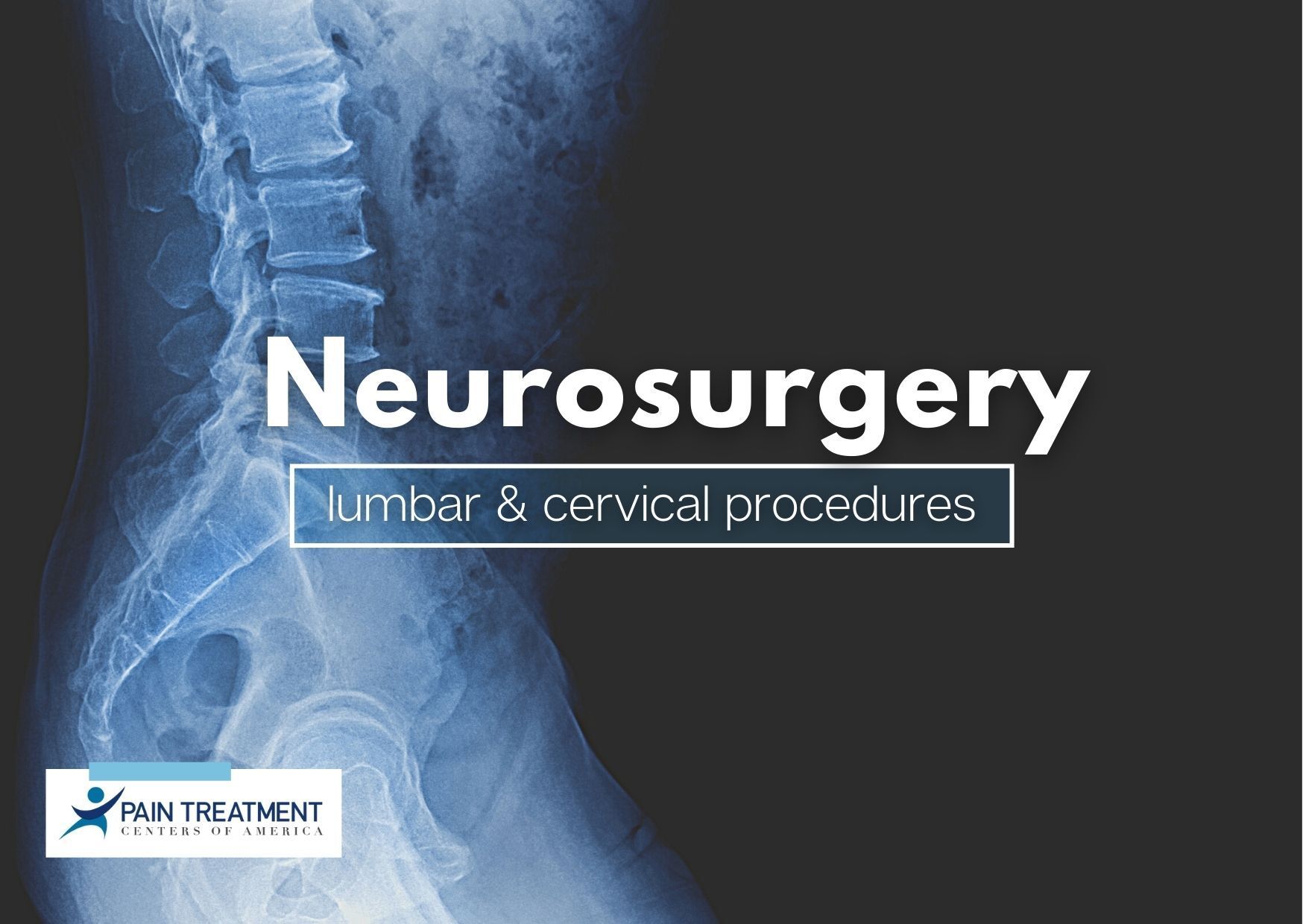
Pain Treatment Centers of America offers a variety of minimally invasive pain treatment procedures that we have perfected to help you achieve pain relief. Our treatments are effective and are at the forefront of pain management. Our goal is to increase a patient's overall function to regain a better quality of life. Below is a list of the surgeries we offer. Please continue reading to learn more about them.
Lumbar Surgeries
Neurosurgery
Surgical procedures involving the nervous system are called neurosurgery. Many people think of neurosurgery as brain surgery, but it is so much more. It is a medical specialty concerned with the diagnosis and treatment of patients suffering from injuries to, or diseases/disorders of, the brain, spinal cord, and spinal column, as well as peripheral nerves throughout the body.
Both adult and pediatric patients are treated in the field of neurosurgery. A neurological surgeon may provide surgical and non-surgical care depending on the nature of the injury or disease.
Microdiscectomy
Microdiscectomy, also known as Microlumbar Discectomy (MLD), is a procedure used to treat patients with a painful lumbar herniated disc. Microdiscectomy is one of the most common surgeries performed by spine surgeons. The herniated or protruding portion of the intervertebral disc that compresses the traversing spinal nerve root is removed during the process. Only in a few cases is a second (repeat) microdiscectomy required.
Hemilaminectomy
Hemilaminectomy is a surgical procedure used to treat excruciatingly painful spine problems. A Hemilaminectomy may be the solution when your vertebrae pinch or restrict your spinal cord or nerve roots. Hemilaminectomy is a surgical procedure frequently used in conjunction with other techniques, such as hemilaminectomy discectomy, to treat a spinal condition.
Your spine is both the foundation of your central nervous system and the main structural component of your skeletal system. When pain in any part of your spine flares up, it can rapidly become chronic and debilitating. A Hemilaminectomy, which means "half a laminectomy," involves removing half as much bone from your spine.
Microforaminotomy
Microforaminotomy is a minimally invasive spinal decompression surgery commonly used to help alleviate spinal nerve root and spinal cord compression. A microforaminotomy is a procedure in which your spine surgeon expands the size of a nerve root pathway—the neuroforamen—by removing bone spurs and soft tissue (e.g., a herniated disc), that is pressing on a neural structure in the spine. Compression of the spinal nerves is a common cause of back and neck pain.
Removal of Synovial Cyst
Synovial cysts form in the joints of your spine and, even though they are benign, they can still grow large enough to pinch spinal nerves. Pain Treatment Centers of America's physicians provide a variety of interventional treatments to manage your pain without any surgical procedure. Still, when your condition worsens, synovial cyst removal is the best choice.
Your treatment will begin with conservative measures such as activity modification and physical therapy when your symptoms are mild. As your pain worsens, interventional pain management techniques such as facet joint or epidural steroid injections may be recommended to relieve your discomfort.
When your pain becomes chronic and severe enough to interfere with your daily routines, it is time to think about cyst removal. Minimally invasive surgery removes synovial cysts, resulting in less postoperative pain and a faster recovery.
Sacroiliac Fusion
The sacroiliac joint fusion procedure is used to stabilize a dysfunctional pelvic joint. When conservative methods fail to provide pain relief, this procedure is used. Pain in the lower back, pelvis, or leg on the affected side can result from sacroiliac joint dysfunction.
Conservative measures such as physical therapy, medications, or injections are used to treat sacroiliac joint dysfunction at first. If conventional treatment does not ease the symptoms, surgery is recommended.
Interspinous Clamps
They function as a spacer between the spinous processes in the back to treat the symptoms of neurogenic claudication caused by lumbar stenosis. Another way, the device separates the spinous functions from the very back of the spine, stretches the ligaments inside the canal where the nerve routes pass, and relieves pressure on the nerve roots.
Initially used only for spinal stenosis, these clamps are now being used to provide a lower stiffness fusion at the decompressed level. As a result, in older patients who do not lead active lives, the physician may recommend an Inter-Spinous clamp/device to boost rigidity at that level after nerve decompression.
Lumbar or Thoracic Kyphoplasty
Kyphoplasty is used to treat spinal compression fractures. These fractures are typically caused by pathologies such as osteoporosis or cancer. They develop because of compression on the diseased bone of the spine. As a result, the spine cannot support the weight and structural stresses that have been placed on it. The vertebra collapses, resulting in pain, hunched posture (kyphosis), and loss of height. The importance of early intervention in treatment cannot be overstated.
The thoracic spine is treated with kyphoplasty. T1-T12 vertebrae make up the thoracic spine. It could also affect the lumbar spine, which includes the L1-L5 vertebrae. A small incision through the back, adjacent to the degenerated vertebra, is required for lumbar and thoracic kyphoplasty. A small tube will be inserted through the pedicle of the diseased vertebral tissue by your surgeon. Fluoroscopic imaging will be used to monitor optimal placement.
After inserting the tube, your surgeon will insert a tiny balloon into the vertebra and slowly inflate it until the vertebra is restored to its proper height. Two balloons may be inserted within the vertebra to ensure symmetry. The small balloon is removed after inflation, leaving a cavity.
The surgeon will then fill the cavity with polymethylmethacrylate, a cement-like substance (PMMA). The patient will be monitored closely after the injection. This procedure could necessitate a 24-hour hospital stay.
Permanent SCS and Trials
Spinal Cord Stimulation (SCS), as effective as it can be for some patients, is not for everyone. Since long-term solutions for severe back pain are required to minimize medication dependency, SCS devices are placed under the skin to provide ongoing pain relief, a kind of "set and forget" solution.
However, before permanent implantation, there is usually a trial period to assess the efficacy of SCS therapy. The trial gives both the doctor and the patient an idea of how successful SCS can be. Since these stimulators are programmable, the electrical pulses can be adjusted to achieve the best results. SCS trials are critical for both effective pain management programming and placement.
SCS trials typically last about a week. To track how the SCS device affects your pain sensations, you will keep a pain log. The trial may include keeping track of any medications you take on an as-needed basis. Adjustments may be made if adequate pain relief is not obtained during the trial week.
A permanent implant can be placed beneath your skin when your trial demonstrates that an SCS device can effectively relieve your back pain. After the incision heals, you can resume normal activities such as showering and swimming.
Permanent Pain Pumps and Trials
Chronic pain is treated with an intrathecal pump. The pump, which is placed beneath the skin of the abdomen, delivers a precise dose of pain medication into the spinal cord, preventing pain signals from reaching the brain. This pain management technique frequently decreases the medicine needed to ease the pain compared to an oral agent.
A trial is performed before implanting a pump to determine the effectiveness of the intrathecal pump. A permanent pump is installed if the trail pump reduces a patient's pain by 50% or more.
Intrathecal pumps are suitable for patients who have not responded well to more conservative pain management treatments. An intrathecal pump is reversible and can be removed at any time.
List of Cervical Surgeries
Cervical Disc Replacement
A diseased cervical disc is removed and replaced with an artificial disc during cervical disc replacement surgery. Before the availability of this procedure, the affected disc was removed, and the vertebrates were fused to prevent motion.
A new type of treatment that the FDA has recently approved is the use of an artificial disc to replace your natural cervical disc. Disc replacement surgery may allow more movement and less stress on your remaining vertebrae than traditional cervical disc surgery.
Anterior Cervical Discectomy and Fusion- One Level
Anterior Cervical Discectomy with Fusion, one level may be performed when a herniated disc pinches a nerve in the neck, and non-surgical treatment has not provided adequate relief. Numbness, weakness, and pain in the arm and neck are the most common symptoms of an Anterior Cervical Discectomy.
The purpose of the Anterior Cervical Discectomy with Fusion is to remove the disc that is pinching the nerve, thereby eradicating the source of discomfort and numbness. One disc engages in a one-level anterior cervical discectomy with Fusion.
Posterior Cervical Foraminotomy and Microdiscectomy
The primary goal of a posterior cervical microdiscectomy is to alleviate pressure on your spinal nerve. A small incision in the back of your neck will be made, and the muscles will be gently spread apart to place the tube through which the surgery will be conducted. After that, specialized instruments will be used to trim the bone and ligament pressing on your nerve. If a herniated disc is causing the issue, it will be removed as well.
The advantages of posterior cervical foraminotomy and microdiscectomy include a small incision, less pain, less blood loss, and a faster recovery time.
With experts from multiple medical specialties, CLIA-certified labs, cutting-edge surgery centers, and more, Pain Treatment Centers of America has the most combined pain management experience of any practice in the region. Call us at (844) 215-0731 or visit our website today to learn more about how we can help you find relief from your pain.